.svg)
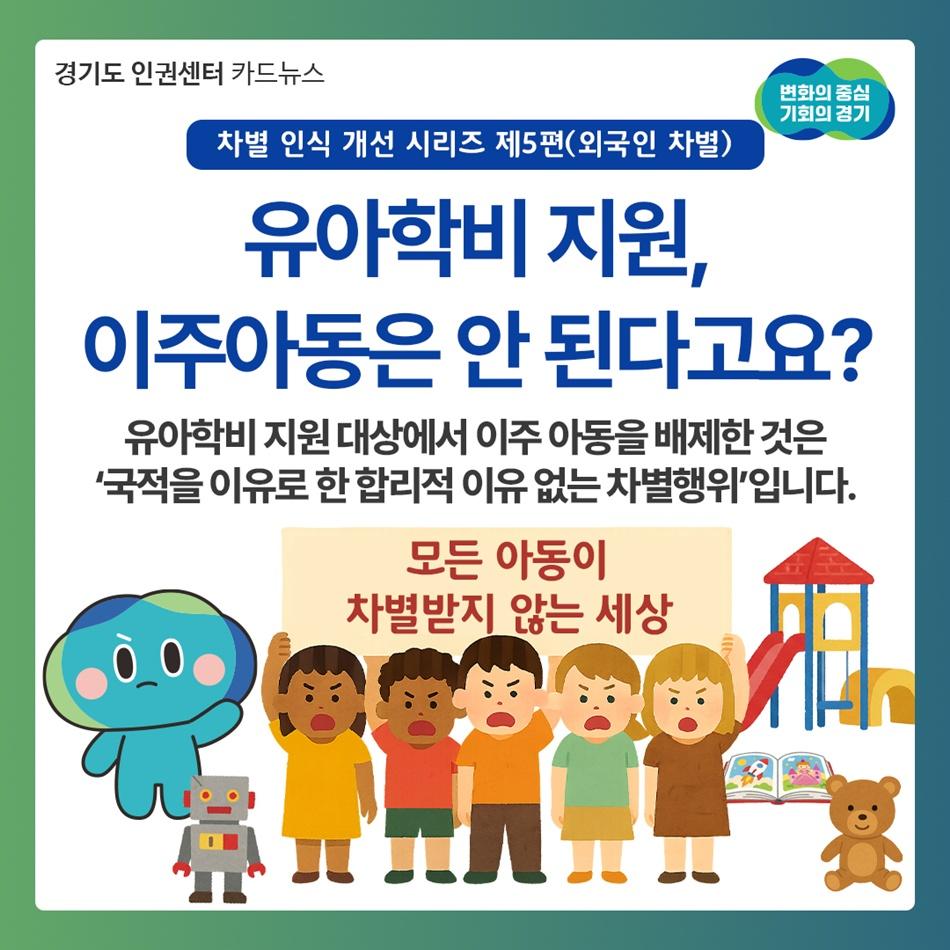
Discrimination Awareness Series Part 5 (Foreigner Discrimination)
Does this mean that migrant children are not eligible for preschool education subsidies?
Excluding migrant children from preschool education subsidies constitutes 'discriminatory treatment without reasonable grounds based on nationality'.
A world where every child is free from discrimination
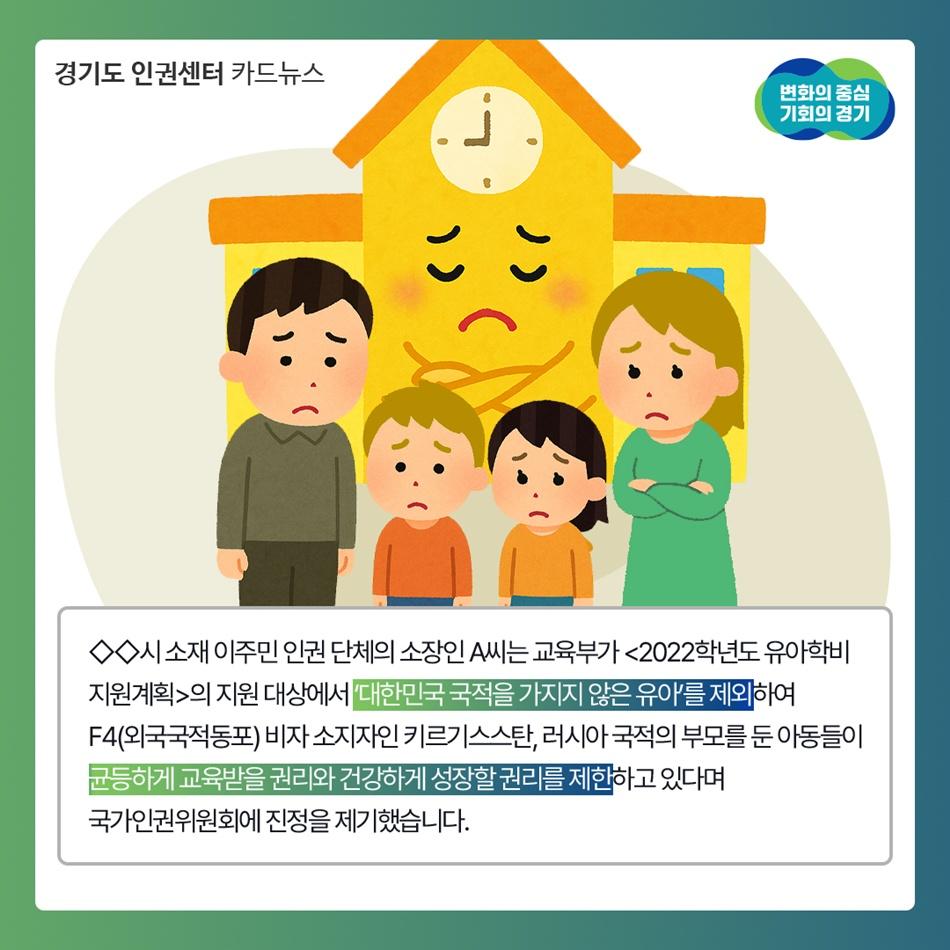
Mr. A, director of a migrant human rights organization based in ◇◇ City, filed a complaint with the National Human Rights Commission of Korea, claiming that the Ministry of Education excluded 'infants without Korean nationality' from the support targets of the <2022 Preschool Education Subsidy Plan>, thereby limiting the equal right to education and the right to healthy growth of children with parents holding F4 (overseas Korean) visas from Kyrgyzstan and Russia.
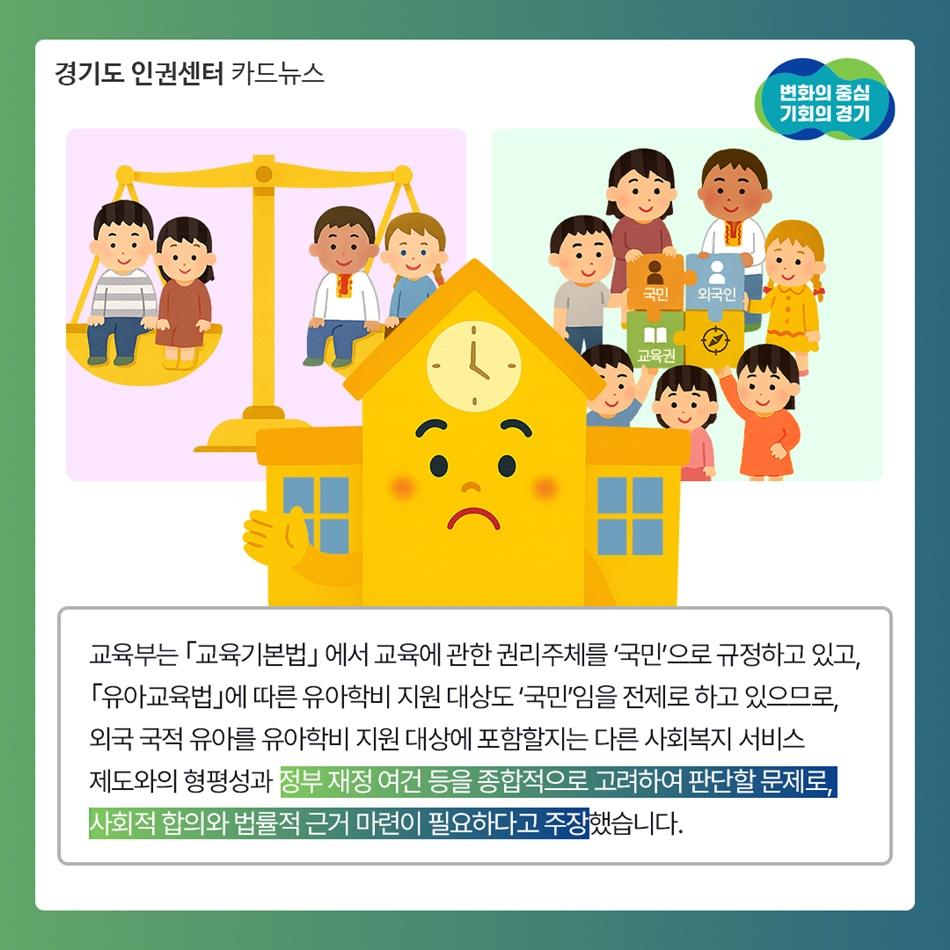
The Ministry of Education claimed that the Education Basic Law defines the subject of rights regarding education as 'citizens' and that the support targets for preschool education subsidies under the Preschool Education Law are also premised on 'citizens'. Therefore, including foreign-nationality infants in preschool education subsidies is a matter to be decided by considering equity with other social welfare services and government financial conditions comprehensively, requiring social consensus and legal basis.
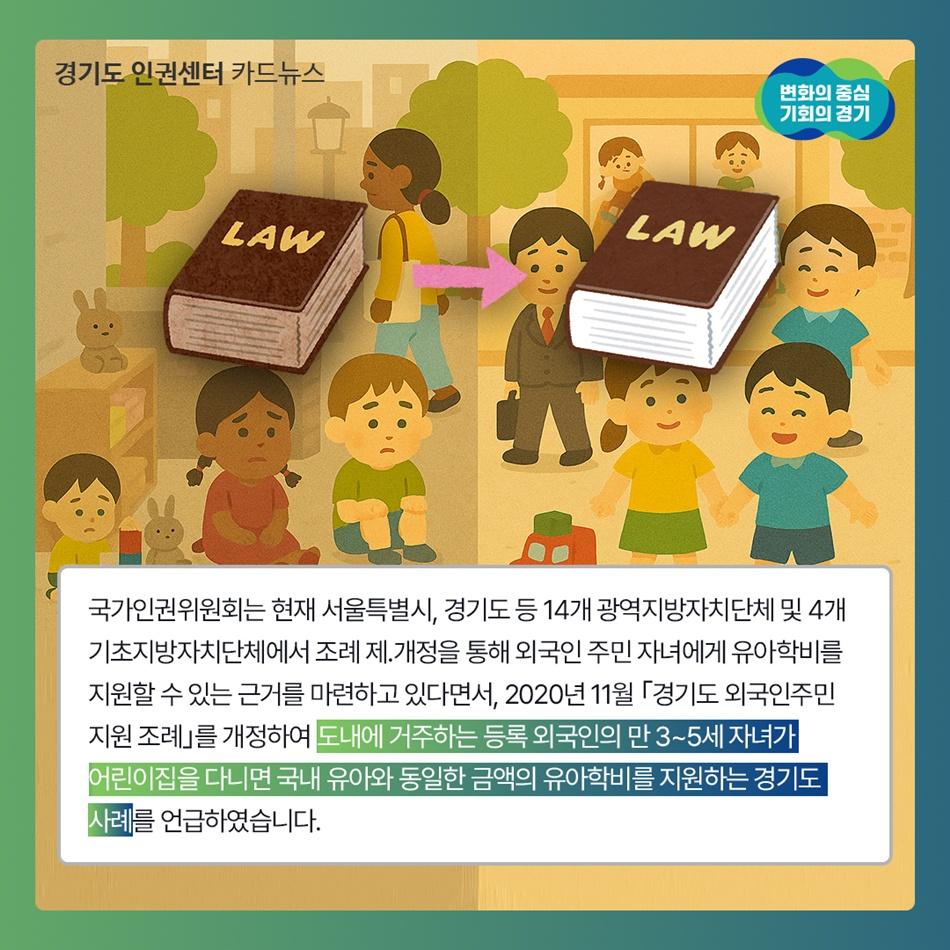
The National Human Rights Commission of Korea noted that 14 metropolitan local governments including Seoul and Gyeonggi-do, and 4 basic local governments have established ordinances to support preschool education for children of foreign residents. It highlighted the Gyeonggi-do case, in which the 'Gyeonggi-do Foreigners' Resident Support Ordinance' was revised in November 2020 to support preschool education for children aged 3-5 of registered foreigners residing in the province in the same amount as for domestic infants.
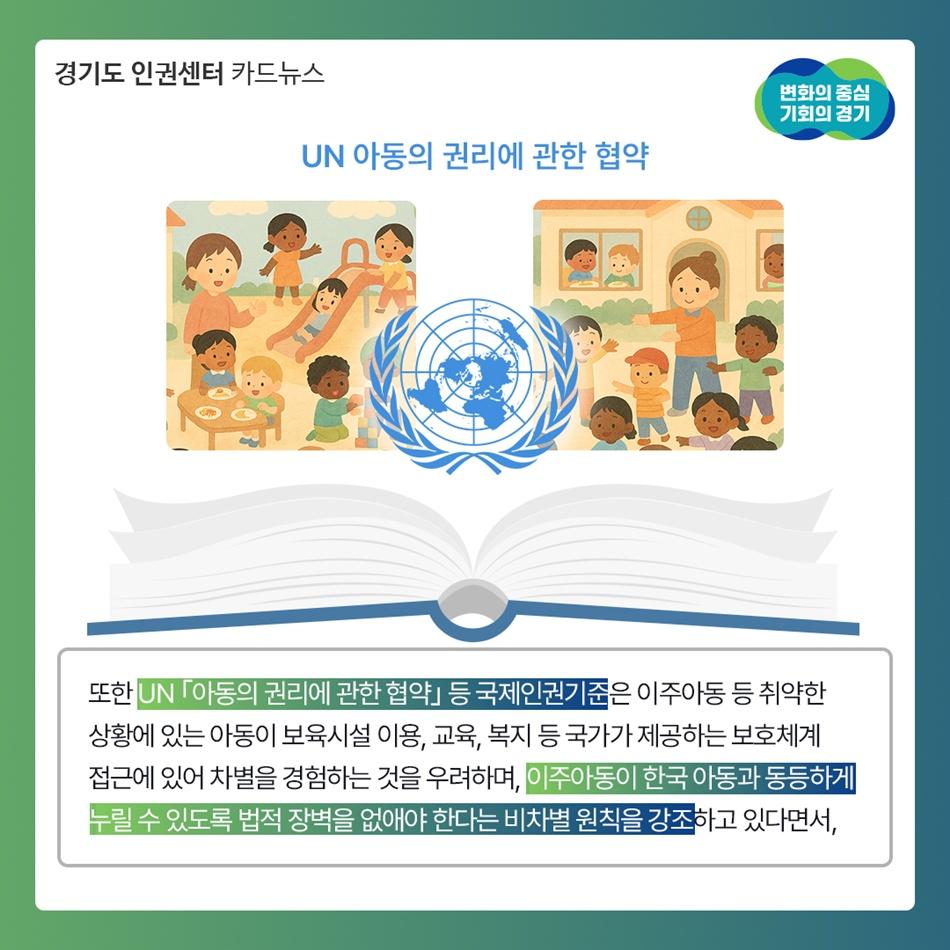
UN Convention on the Rights of the Child
International human rights standards such as the UN 'Convention on the Rights of the Child' raise concerns about children in vulnerable situations like migrant children experiencing discrimination in access to state-provided protection systems such as childcare facilities, education, and welfare, and emphasize the non-discrimination principle that migrant children should be able to enjoy rights in the same way as Korean children by removing legal barriers.
After considering that *the preschool education subsidy program is not simply a charitable policy, that the program purpose of 'providing equal educational opportunities at the start of life' is also not required for migrant children, and that the non-discrimination principle of the 'Convention on the Rights of the Child' is naturally to be reflected, and that government financial conditions and other issues are tasks to be solved through consultation with related agencies rather than justification for excluding migrant children, the Commission judged that the Ministry of Education's arguments lack reasonable grounds.
※ A program that supports the kindergarten/care center tuition fees for children aged 3-5 without regard to the guardian's income level
If migrant children do not receive adequate care, it leads to an evil cycle of ensuring the rights to survival and development of children and leading to child poverty, and there is concern that this will lead to a burden on the entire society in the future or hinder the social integration of migrants. Therefore, the Commission recommended that a joint body with central government agencies and experts be formed to establish measures to expand preschool education subsidies so that foreign-nationality migrant children residing in Korea do not receive discrimination in preschool education subsidies.
Even if nationality is different, the growing mind is the same
The Gyeonggi-do Human Rights Center provides consultation, investigation, and recommendations for human rights violations that occur during the performance of business by Gyeonggi-do and its affiliated administrative agencies, provincial funded institutions, provincial delegated institutions, groups supported by the province, and various social welfare facilities.
Phone number: 031-8008-2340 (031-120-ARS 2nd+6th button)
Operating hours: morning 9:00~11:30, afternoon 13:00~17:00
Email: gghrc@korea.kr
Website: www.gg.go.kr/humanrights